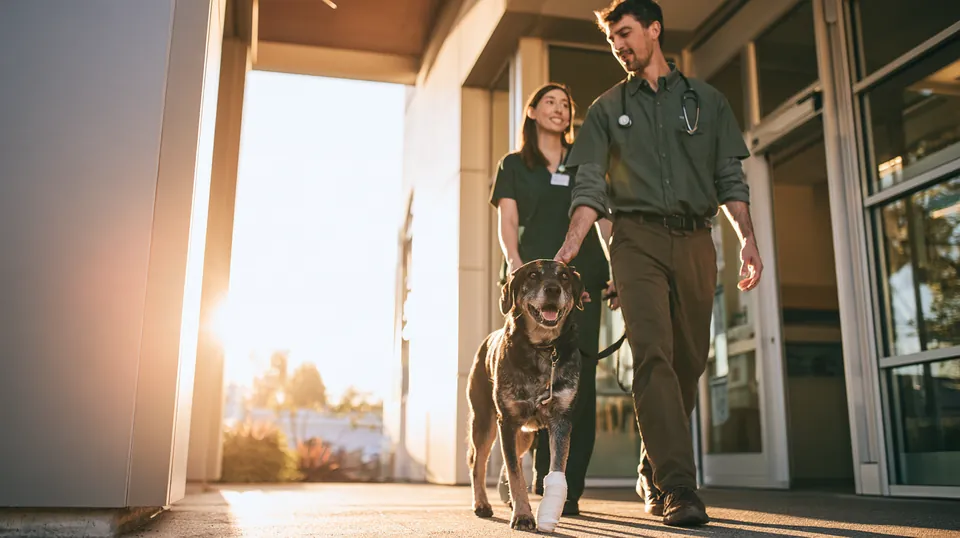
Yes, you can finance an emergency vet bill, and most families who face one do some version of it. Clinics accept payment plans, medical credit cards, pet insurance reimbursements and personal loans, and Tripoint Lending can help you compare loan offers from several lenders while your pet is still being treated. The harder part is choosing quickly without overpaying, because emergency hospitals usually want a deposit before treatment starts.
This guide walks through what urgent veterinary care typically costs, when a personal loan fits, the realistic ways to pay for it, how to read an estimate under pressure, and how to decide whether borrowing makes sense for your household. Every dollar figure below is a typical range, not a quote. Prices vary widely by region, clinic and the size of your animal.

What Emergency Vet Care Typically Costs
An emergency visit commonly costs $150 to $250 just for the exam, and a full workup with diagnostics and an overnight stay often lands between $1,500 and $5,000, depending on the problem and where you live.
Emergency and specialty hospitals charge more than a regular daytime clinic because they staff veterinarians, technicians and equipment around the clock. The exam fee alone is usually higher than at your family vet, and the total grows quickly once imaging, fluids or surgery are added. The table below shows typical estimated ranges for common emergencies in dogs and cats.
| Emergency situation | Typical estimated cost range | What drives the cost |
|---|---|---|
| Emergency exam and triage | $150–$250 | After-hours staffing, initial stabilization |
| X-rays and basic bloodwork | $300–$700 | Number of views, lab panels ordered |
| Toxin ingestion (chocolate, grapes, medication) | $300–$1,500 | Induced vomiting, activated charcoal, monitoring |
| Bite wounds or deep lacerations | $500–$2,000 | Sedation, wound repair, drains, antibiotics |
| Urinary blockage in a male cat | $1,500–$4,000 | Catheterization, two to four nights in hospital |
| Swallowed object requiring surgery | $2,500–$7,000 | Abdominal surgery, anesthesia, recovery stay |
| Bloat (gastric dilatation-volvulus) | $3,000–$8,000 | Emergency surgery, intensive care |
| Fractured leg needing surgical repair | $2,000–$5,500 | Plates or pins, specialist surgeon, rechecks |
Two things push these numbers up more than owners expect. First, hospitalization is billed per night, often $400 to $1,200 for each day in intensive care. Second, follow-up rechecks, bandage changes and take-home medication are frequently billed separately after discharge, adding a few hundred dollars that never appeared on the first estimate.
Ways to Pay a Vet Bill Over Time
The main options are a clinic payment plan, a medical credit card, pet insurance reimbursement, a personal loan through a lender network such as Tripoint Lending, savings, or help from a charity, and each one differs in cost, speed and how much flexibility it gives you.
Clinic payment plans
Some independent practices let longtime clients split a bill into two or three installments. Emergency hospitals rarely do this for new patients, and the plans that exist are usually short, often 60 to 90 days. Ask, because the answer is sometimes yes, and an in-house plan may carry no interest at all.
Medical and veterinary credit cards
Many clinics accept healthcare credit cards that advertise promotional periods with no interest if the balance is paid in full within six to eighteen months. The catch is deferred interest: if any balance remains when the promotion ends, interest is often charged back to the original purchase date, commonly at a rate in the high twenties. These cards work well for disciplined borrowers who are confident they can clear the whole balance in time.
Pet insurance
If your pet was already insured before the emergency, a policy may reimburse 70% to 90% of covered costs after your deductible. Most insurers reimburse after you pay, though, so you still need to cover the bill upfront and wait days or weeks for the check. A new policy will not cover a condition that already exists. Some owners bridge that gap with a short personal loan and repay it as the reimbursement arrives.
Personal loans
An unsecured personal loan gives you a lump sum with a fixed rate, a fixed monthly payment and a set end date. There is no deferred interest trap, and personal loan funds can be used at any clinic, including a specialist referral hospital. Through Tripoint Lending you can check offers from lenders in its network for amounts from $500 to $5,000, with terms commonly between about 3 and 24 months. Our guide to pet care loans explains how these loans are set up specifically for veterinary costs.
Charities and assistance funds
Breed rescues, local humane societies and national nonprofits sometimes offer partial grants for urgent care. Funds are limited and approvals can take days, so they tend to help most with follow-up treatment rather than the deposit you need tonight.
How Tripoint Lending Helps With Emergency Vet Bills
Tripoint Lending is a free loan-connection service, not a lender, that lets you submit one request and see offers from multiple lenders, so you can compare rates and payments rather than accepting the first financing pitched at the front desk.
The Tripoint Lending request is short enough to finish from a waiting room on your phone. You enter the amount you need, basic income details and contact information. Checking offers uses a soft credit inquiry, which does not affect your credit scores. If a lender in the Tripoint Lending network can make a personal loan offer, you see the estimated APR, term and monthly payment before deciding anything. A lender may run a hard inquiry only if you accept an offer and continue with its application.
A few points are worth being clear about, because emergencies are when misunderstandings cost the most:
- Tripoint Lending does not make credit decisions, and it never charges you for a tripoint loan request. Each lender sets its own approval rules, APR, fees and terms.
- Using the service is free, and there is no obligation to accept any offer you see.
- Funding is often as soon as the next business day after approval, but timing depends on the lender and your bank. A Tripoint loan offer will not settle a deposit due within the hour, so you may still need a card for the first payment.
- Typical APRs from lenders in the network run from about 6.99% to 35.99% APR. That is an estimate; your actual rate depends on the lender, your credit and your income.
People searching for tri point lending during a crisis often want to know whether they can request personal loan offers before they know the final bill. You can, but it helps to request an amount close to the high end of the vet's estimate so you are not applying twice.
What Monthly Payments Might Look Like
A $1,500 vet bill financed over 12 months at an estimated 24.99% APR costs roughly $142.56 a month and about $210.71 in total interest, while longer terms lower the payment but raise total cost.
Seeing the trade-off in numbers makes the personal loan decision less abstract. The figures below are estimates calculated with standard amortization; actual offers vary by lender and borrower.
| Amount borrowed | APR (estimate) | Term | Monthly payment (est.) | Total interest (est.) |
|---|---|---|---|---|
| $1,500 | 17.99% | 12 months | $137.51 | $150.15 |
| $1,500 | 24.99% | 12 months | $142.56 | $210.71 |
| $2,000 | 24.99% | 12 months | $190.08 | $280.94 |
| $3,000 | 17.99% | 18 months | $191.40 | $445.25 |
| $3,000 | 35.99% | 18 months | $218.11 | $925.99 |
| $4,000 | 24.99% | 24 months | $213.47 | $1,123.18 |
As a representative example, $2,000 borrowed over 12 months at 24.99% APR works out to about $190.08 per month, with total repayment near $2,280.94 and total interest around $280.94 (estimate). Notice how the same $3,000 costs roughly twice as much in interest at 35.99% as it does at 17.99%. That gap is the reason comparing several personal loan offers matters, and you can see how today's typical ranges break down on our current personal loan rates page. To test your own numbers, the personal loan payment calculator lets you change the amount, APR and term.
Reading the Vet's Estimate Before You Borrow
Ask for a written, itemized estimate with a low and high range, and borrow against the high figure only after you understand which items are essential tonight and which can wait.
Emergency hospitals almost always provide a treatment plan with two numbers, because nobody knows exactly how a sick animal will respond. A plan might read $2,200 to $3,600 for a dog with a suspected obstruction. The low end assumes the problem resolves with medication and monitoring; the high end assumes surgery and a longer stay. Here is how to work through it calmly:
- Ask what is urgent. Stabilization, pain relief and diagnosis usually cannot wait. Some lab panels or a dental issue spotted during the exam often can.
- Ask about the deposit. Many hospitals require 50% to 75% of the low estimate upfront. Know that number before you decide how to pay.
- Ask for daily updates. Request a call if costs are about to pass the high end, so you are not surprised at discharge.
- Ask about step-down care. Once stable, some pets can transfer to your regular vet for continued care at lower daily rates.
- Ask what discharge will include. Medications, an e-collar and a recheck visit may add $100 to $400.
With that information, you can size a personal loan request sensibly. If the estimate tops out at $3,600 and you have $600 in savings, a $3,000 request is reasonable, whether you send it through tri point lending or another source. Borrowing $5,000 "just in case" adds interest you may never need to pay.
Is a Personal Loan the Right Way to Pay?
A personal loan suits owners who need more than a few hundred dollars, want a predictable payment, and cannot confidently clear a promotional card balance before deferred interest applies.
No single option fits everyone. The comparison below summarizes how the main choices tend to stack up.
| Option | Typical cost | Best for | Main risk |
|---|---|---|---|
| Savings or emergency fund | No interest | Anyone who has it | Leaves you thin for the next surprise |
| Clinic installment plan | Often no interest | Established clients, smaller bills | Short window, not always offered |
| Promotional medical card | 0% if paid in time, then high APR | Borrowers sure to repay within the promotion | Deferred interest on the full balance |
| Regular credit card | Often 20%+ APR, variable | Small amounts repaid quickly | Minimum payments stretch for years |
| Personal loan | About 6.99%–35.99% APR (estimate) | Larger bills needing a fixed plan | Fees and higher APR with weaker credit |
A personal loan is usually not the best tool for a $250 exam fee you can cover from your next paycheck. It tends to make the most sense when the bill is $1,000 or more, your credit card limit is tight, and you value knowing the exact date the debt ends. Personal loans also keep the vet bill off your revolving credit, which can help your credit utilization compared with maxing out a card.
Before relying on one, check the basic personal loan eligibility requirements lenders commonly look for, such as steady income, a U.S. bank account and age 18 or older.
Borrowing Responsibly During a Pet Emergency
Responsible borrowing means requesting only what the treatment plan needs, choosing a payment that fits your real monthly budget, and reading every fee before you accept an offer.
Stress pushes people toward fast yeses. A few habits help you avoid regret later:
- Run the payment against your budget. If a $190 monthly payment means skipping a utility bill, choose a longer term or a smaller amount and cover the difference another way.
- Look for origination fees. Some personal loan lenders deduct a fee from the loan amount, so a $2,000 loan might deposit $1,900. Ask for the net figure.
- Check for prepayment penalties. Many personal loans allow early payoff without a fee. If an insurance reimbursement arrives later, you can put it straight toward the balance.
- Set up autopay. A missed payment can bring late fees and hurt your credit, and automatic payments remove that risk.
- Keep the paperwork. Save the itemized invoice for insurance claims and your own records.
When you compare tripoint lending personal loans with a medical card or other options, keep the conversation centered on total cost, not just the monthly figure. A low payment over 24 months can still cost several hundred dollars more than a slightly higher payment over 12.
Planning After the Emergency Is Over
Once your pet is home and recovering, the best next steps are setting up a small pet emergency fund, reviewing insurance options, and paying down any loan or card balance as fast as comfortably possible.
Recovery is a good moment to plan, because the cost is fresh in your mind. Even $25 a week into a separate savings account becomes $1,300 in a year, enough to cover most exam-and-diagnostics visits without needing a personal loan at all. If you took a Tripoint loan through a network lender, consider rounding your payment up by $20 or $30; on a $3,000 balance at 24.99%, a little extra each month shortens the payoff and trims interest. Tripoint Lending does not service the loan, so make those extra payments directly with your lender.
It also helps to compare pet insurance plans while your pet is healthy, keeping in mind that the condition just treated may now be excluded. Finally, ask your regular vet about preventive steps tied to what happened, such as a basket muzzle for a dog that eats socks or a diet change for a cat with urinary crystals. Prevention is the cheapest care there is, and it is far cheaper than any personal loan.
Many owners tell us the hardest part was not the money but deciding quickly while scared. Knowing your options ahead of time, and knowing that Tripoint Lending lets you compare personal loan offers without obligation, can make the next emergency feel a little more manageable.
Emergency Vet Financing Questions
Can I finance a vet bill with bad credit?
Often, yes. Some lenders work with fair or limited credit, though the APR is usually higher. A clinic installment plan or a co-signer may also help, and checking offers with a soft inquiry will not affect your scores.
Does the lender pay the vet directly?
Most personal loan lenders deposit funds into your bank account, and you pay the clinic yourself. That gives you flexibility to use the money for follow-up care or medication at a different provider.
Should I apply before I know the final bill?
You can. Request an amount near the high end of the written estimate so you are not applying twice, and pay down any unused balance early if your lender allows it without a penalty.
Related Posts

Typical surgery and recovery costs, a line-by-line budget template, and smart ways to fund the gap before your pet's procedure date.

From the moment you accept an offer to the deposit in your account, see how long personal loan funding takes and how to avoid delays.